2020 Seed Labs
Search
  • Home
  • About
    • About Us
    • Alberta Lab
    • Manitoba Lab
    • Chile Lab
  • Services
    • Services Overview
    • Seed Testing Services
    • Soil Testing
    • Herbicide Resistance Testing
    • Potato Testing
    • Crop Inspection
    • Seed Import and Export
    • Molecular Diagnostics
    • Research & Development
    • Training & Consulting
    • Greenhouse
  • Resources
    • News
    • Events
    • Learning Centre
    • Industry Resources
    • Videos
    • Online Forms
    • Tech Bulletin
    • Frequently Asked Questions
  • Alive
  • Contact Us
    • Contact Us
    • Careers
  • Submit a Sample
    • Sample Drop Off Partners
  • Log In
the-value-seed-testing-how-tests-work-banner
June 1, 2026

The Value in Seed Testing and How Tests Work Together

20/20 Seed Labs Seed Health

A report of seed analysis can look pretty technical at first glance. Numbers, percentages, abbreviations, pathogen names. But every test result attempts to answer a simple question that growers, seed retailers, and processors are trying to answer: What am I really putting into the ground, and what kind of crop can I realistically expect back? That’s where seed testing earns its value.

Not because it checks a regulatory box, but because every test tells part of the story of how that seed is likely to perform under field conditions.

Anyone can look at a seed lot and think it “looks good.” Clean colour. Uniform size. Maybe it even handled well through the plant. But seed quality problems rarely announce themselves until emergence is uneven; storage issues show up, or disease starts moving through a field weeks later. The real value of testing is catching those issues before the crop has a chance to remind you the hard way.

Take germination testing, for example. Most people know it as the standard test required for seed sales, but it’s really the starting point for understanding seed performance. A germination test doesn’t just give you one percentage — it tells you how many seedlings developed normally, how many were weak or abnormal, and how many seeds were fresh or dead. In other words, it gives context. Two seed lots can both test at 90% germination and still perform very differently in the field. That’s where vigour testing becomes important.

Germination tells you what seed can do under ideal conditions. Vigour helps predict what it will do under stressful ones. Cold soils, inconsistent moisture, delayed emergence, crusting, early-season stress — that’s real farming. Vigour testing measures the seed’s ability to establish healthy, uniform seedlings when conditions aren’t perfect, which is usually where the difference between an average stand and a strong one starts to show.

Moisture testing is another one that’s easy to underestimate until storage becomes a problem. A small moisture difference can mean the difference between seed that stores safely and seed that begins to heat, lose germination, or develop fungal issues in the bin. It’s one of the simplest quality assurance tests available, but also one of the most important for protecting the longevity and integrity of stored seeds.

And while moisture protects storage quality, disease diagnostics protect field potential.

Fungal screens in cereals and complete disease diagnostics in pulses are designed to identify the seed-borne pathogens most likely to impact emergence, plant health, and final yield. In cereals, that includes pathogens like Fusarium graminearum which causes Fusarium Head Blight. In pulses, testing often targets diseases like Ascochyta blight. These infections are not always visible, and sometimes the cleanest-looking seed lots still carry disease pressure capable of causing serious problems once conditions favor development.

The same idea applies to smut testing in barley and wheat. Smut pathogens infect the seed embryo itself, meaning the issue starts long before symptoms become obvious in the field. Identifying those risks early helps growers make treatment and seed management decisions before infection spreads further into production acres.

Some tests are less about disease and more about marketability and crop management.

Protein testing, for instance, plays a major role in determining nutritional and market value in many crops. Falling Number testing helps identify sprout damage by measuring alpha-amylase enzyme activity — critical information when end-use quality matters. In years with challenging harvest conditions, that number can significantly affect grading and marketing opportunities.

Then there are the practical tests growers use every season to fine-tune seeding decisions.

1000 Kernel Weight and Seeds Per Pound both help estimate seed size and density, allowing for more accurate seeding rate calculations. Because seed size varies year to year, relying on assumptions instead of measurements can quickly lead to thinner or overly heavy plant populations. These tests help take the guesswork out of achieving target stands.

Purity and Percent Pure Seed testing complete the picture by identifying what’s present in the sample beyond the intended crop. Weed seeds, other crops, inert matter — it all matters. Not just from a grading standpoint, but from a long-term land management perspective. Introducing problem weeds or contamination into clean fields can create issues that last well beyond a single growing season and cost a lot money in control and yield losses.

The interesting thing about seed testing is that its value often becomes most obvious when something goes wrong. Poor emergence. Uneven stands. Storage spoilage. Disease carryover. Dockage concerns. Rejected loads. Suddenly the cost of testing feels very small compared to the cost of uncertainty.

The best operations don’t use seed testing only when they suspect a problem. They use it as part of routine decision-making because they understand good crops are built long before the planter enters the field.

At the end of the day, seed testing is really about confidence.

Confidence in what’s being sold. Confidence in what is being planted. Confidence that the crop has the best possible start before weather, environment, and field conditions begin adding variables no one can control.

If you’re not sure where to start, simply book a consultation with our team of experts today.

https://2020seedlabs.ca/contact-us/

 

May at 20/20 Seed Labs The Hidden Cost of Weed Contamination in Forage

Related Posts

Seed Health

What Do You Need From Your Seed Lab?

Seed Health

Treated vs. Untreated Seed: What You Don’t See Can Cost You

Seed Health

What Happens to Seed Quality After It Leaves the Lab

20/20 Seed Labs Inc. is a member of the following organizations:

International Seed Testing Association
Member of Seeds Canada
Canadian Seed Growers' Association
Society of Commercial Seed Technologists.
International Society for Seed Science (ISSS)

20/20 Seed Labs Inc. Awards:

Innovation Showcase Finalist Logo
SeedWorld Most Innovative Product Logo
Germination Top 10 Innovative Logo
AsTech Awards Logo
2020 Seed Labs

2020 Seed Lab Alive Logo

Contact Us

support@2020seedlabs.ca

Manitoba

3489 Pembina Hwy
Winnipeg, MB R3V 1A4

Phone: 1-204-261-3755

Alberta

507 – 11 Avenue
Nisku, AB T9E 7N5

Phone: 1-877-420-2099

© Copyright 20/20 Seed Labs Inc. 2024. All rights reserved. Privacy Policy
  • 1-877-420-2099
  • support@2020seedlabs.ca

X

How to Submit a Sample
to 20/20 Seed Labs Inc.

  Please use our our ‘3-Step Process’ when submitting samples to be tested.

Take a Representative Sample

Select Your Testing and Enter Your Sample Details

Ship or Drop Off Your Sample To Our Lab

STEP 1: Take a Representative Sample

We provide testing on seeds, plants and soil. Select the type of sample below that you are submitting for sample collection instructions.

  • Seed Samples

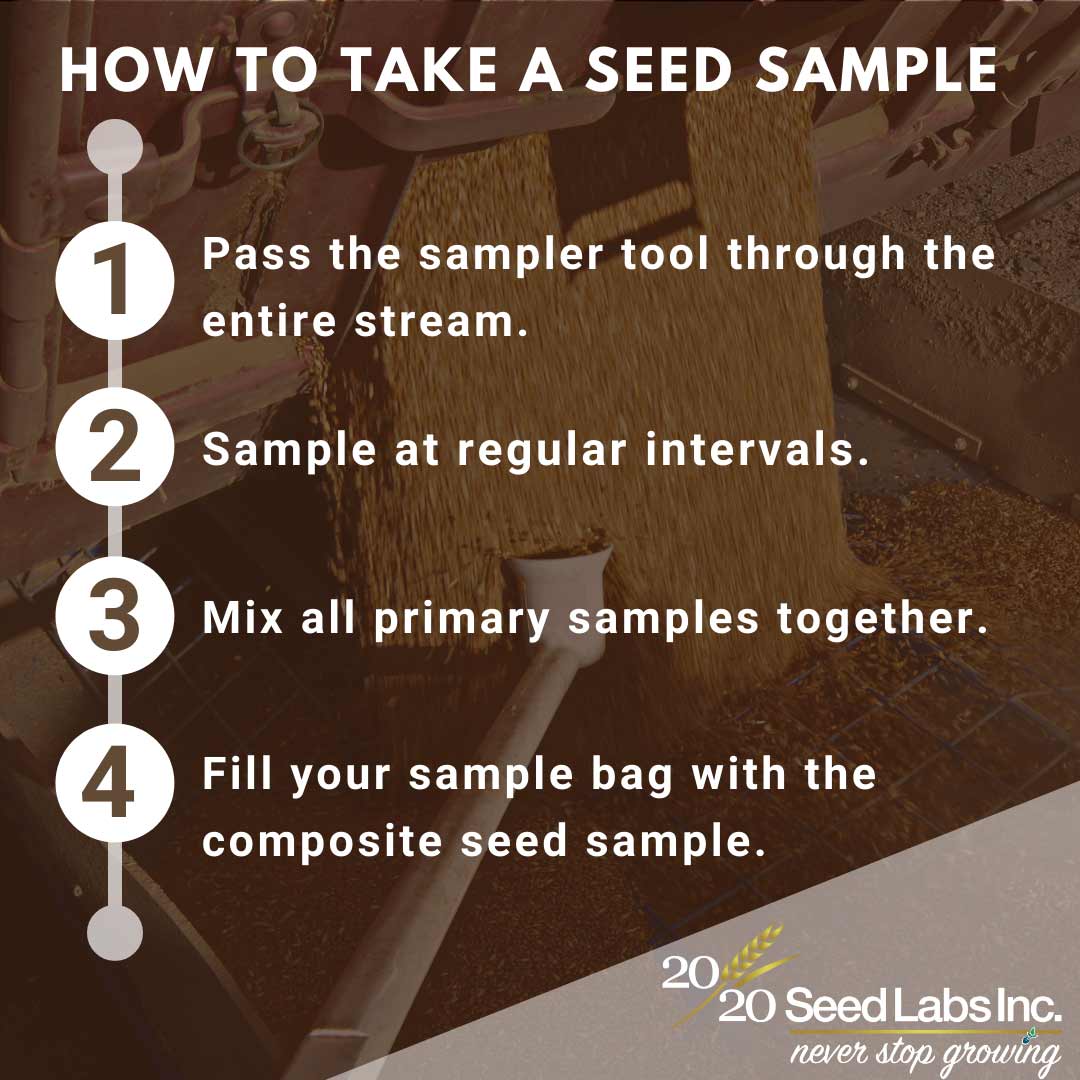
    The table below outlines the type of seed test and required sampling amount needed for each test. Be sure to follow the 4 steps indicated to collect your sample.

    Cereals

    Seed Health & Disease Tests
    500 g (2 1/2 cups)
    Purity Tests
    1 kg (5 cups)

    Pulses

    Seed Health & Disease Tests
    500 g (3 cups)
    Purity Tests
    1 kg (6 cups)

    Grasses & Forages

    All Testing
    250 g

    Canola

    All Testing
    250 g
    20/20 Seed Labs - How to Take a Seed Sample
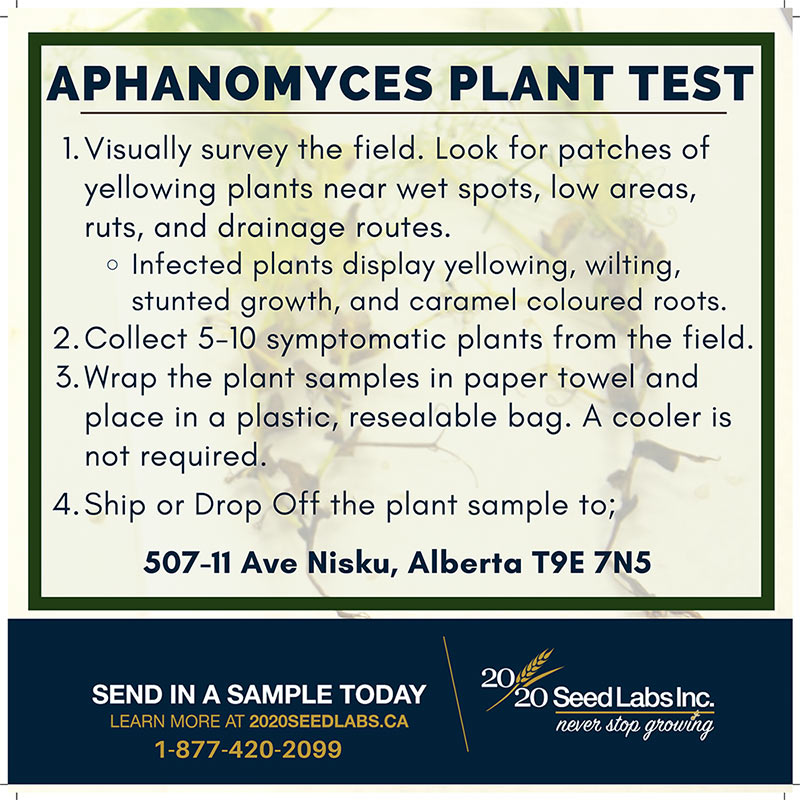
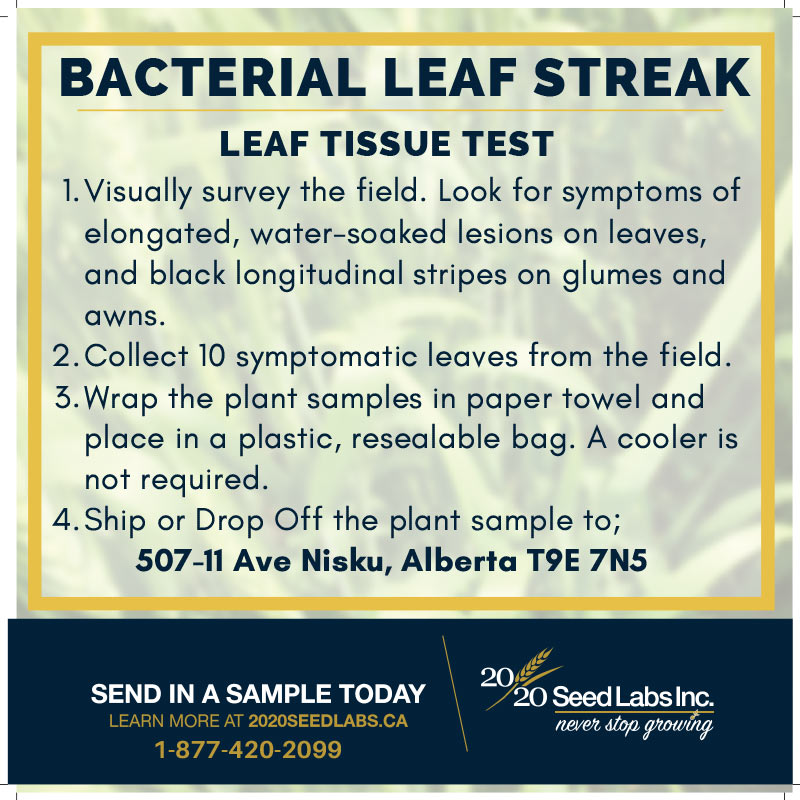
  • Plant Samples

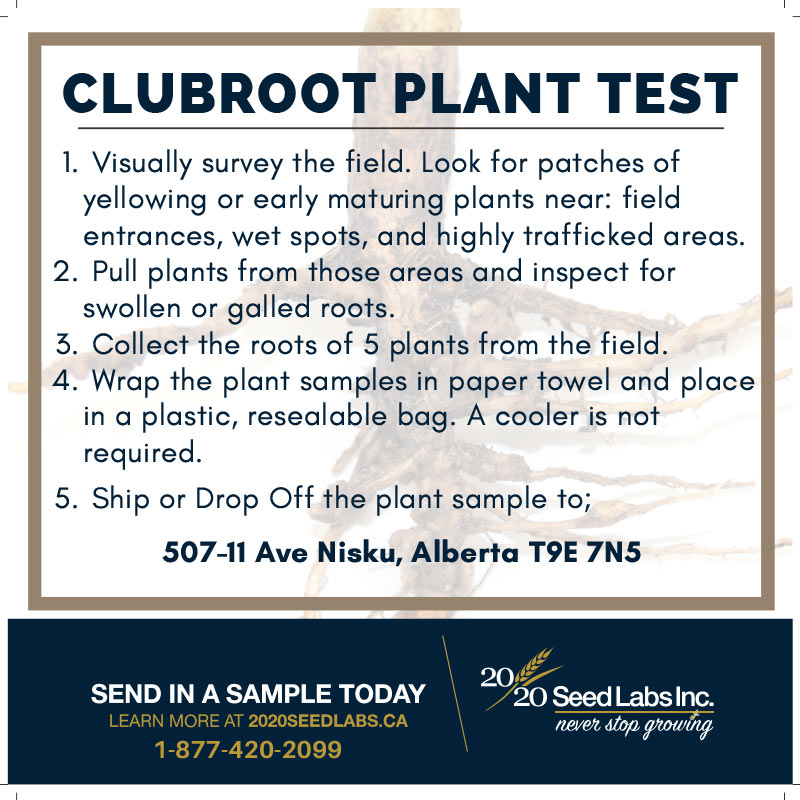
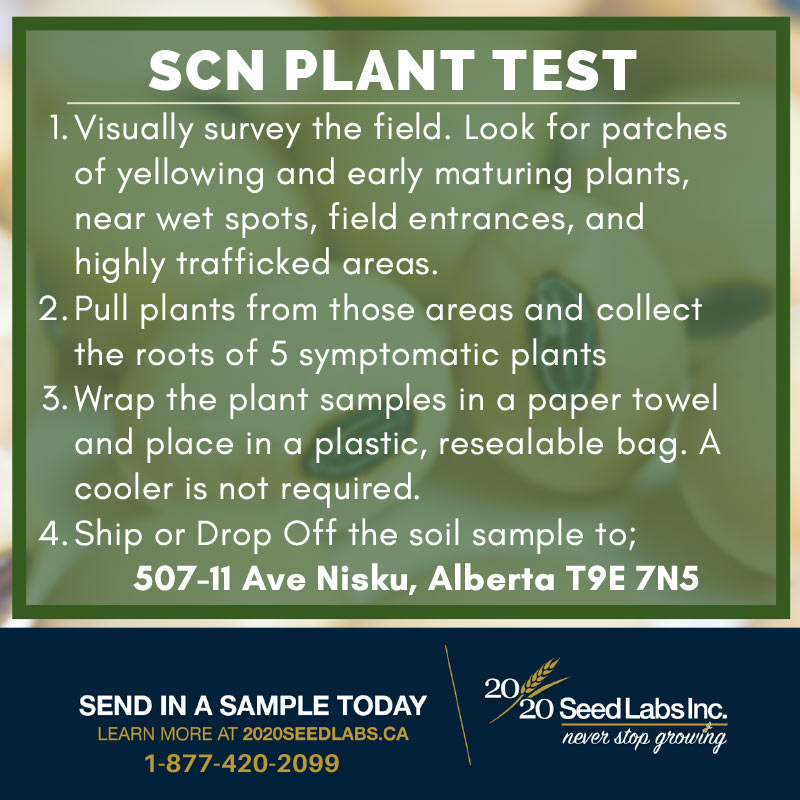
    The sampling cards below outline the steps to collect your required plant samples for testing.


  • Soil Samples

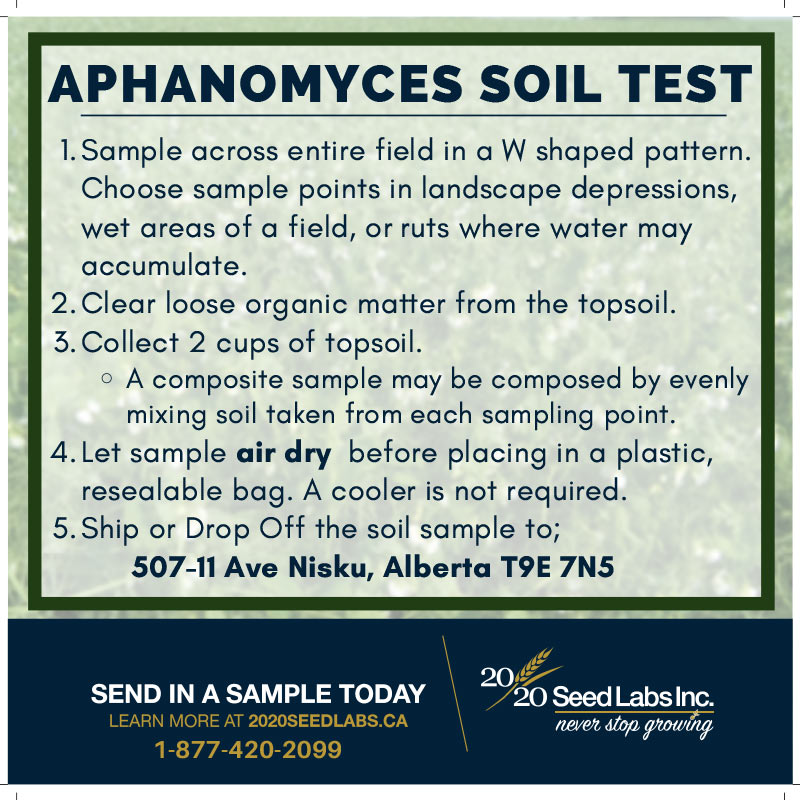
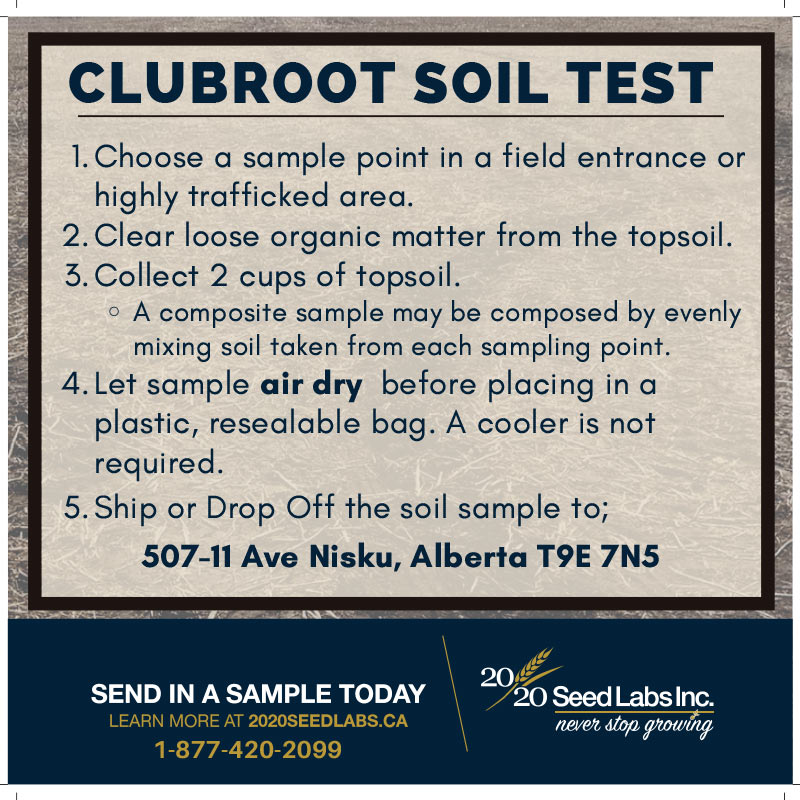
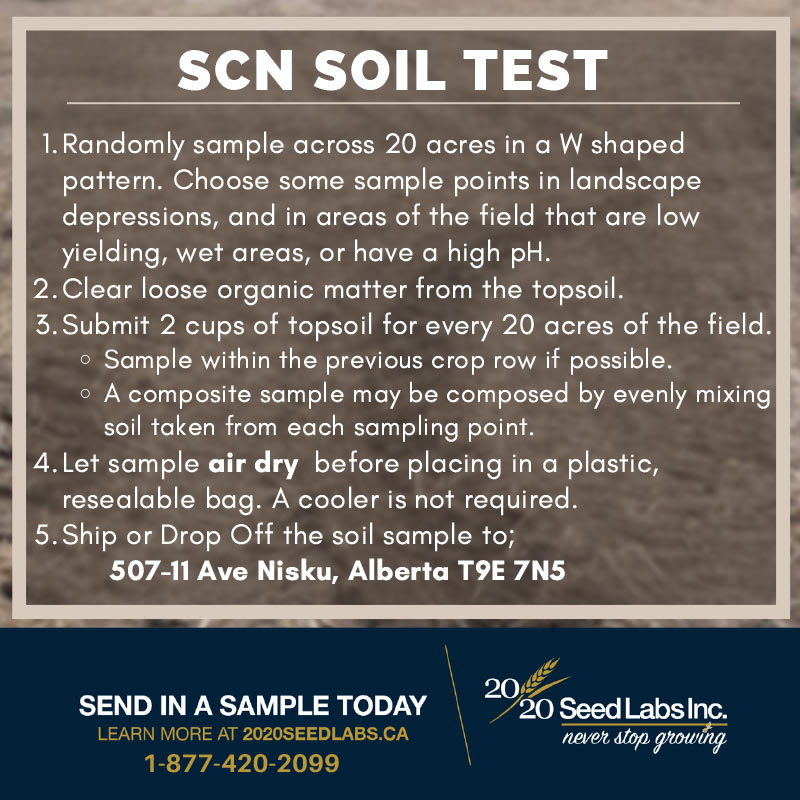
    The sampling cards below outline the steps to collect your required soil samples for testing.


STEP 2: Select Your Testing and Enter Your Sample Details

Select the testing services you will require from the pricing schedule below, then choose how you want submit your sample: 

Option 1:
Submit your sample online: 

Option 2:
Write Your customer number and sample details on the sample bag and prepare the sample for shipping or drop-off.

STEP 3: Ship or Drop Off Your Sample to Our Lab

Mailing Addresses

NISKU, ALBERTA

20/20 Seed Labs, Inc.
507-11 Avenue
Nisku, AB T9E 7N5
Toll Free: 1-877-420-2099

WINNIPEG, MANITOBA

20/20 Seed Labs, Inc.
3489 Pembina Hwy
Winnipeg, MB R3V 1A4
Toll Free: 1-866-540-7333

After Hours Drop Off

There is a locked and secure after hours drop off box in front of both the Nisku, Alberta and Winnipeg, Manitoba 20/20 Seed Labs offices. Please leave your samples in the drop off box if you are dropping off a sample on the weekends, a statutory holiday, or after 4:30 p.m. on a weekday.

Sample Drop Off Locations

agroplus-logo

Agro Plus Inc.

3895-9th Avenue North
Lethbridge, Alberta
T1H 6G8
Phone: 1-403-327-7070

down-to-earth-labs-logo

Down to Earth Labs

3510-6th Avenue North
Lethbridge, Alberta
T1H 5C3
Phone: 1-403-328-1133

ici-logo

Independent Crop Inputs Inc.

Hwy #3, 2.5km East of Barnwell, Alberta
Box 4690, Taber, Alberta
T1G 2E1
Phone: 1-403-223-1325

  • Step 1: Review Requirements

    Requirements for Submitting Samples

    Please submit the correct sample size for the test required.

    Germination and Vigour Tests
    Most tests of this type require approximately 250 grams or 1 cup of seed. For very large seeds such as some types of peas or beans, up to twice as much seed may be required.

    Disease and Seed Health Tests
    The quantity of seed for most disease testing is the same as a germination test. Some tests with special requirements may require larger amounts of seed.

    Purity Tests
    Test volumes for purity and % pure seed vary with crop type and are available on the purity weight form.

    Rhizobia Test
    Small seeded legumes require a 1 cup sample. Large seeded legumes require a minimum 2 cup sample. Inoculant, loose peat, granules, and liquid  should be tested in the original sealed container size.

    Canadian Seed Institute Samples
    Follow the CSI instructions for the crop type and the weight to be submitted. Example: Wheat, Purity = a minimum of 1 kg of seed.

    APHIS Samples
    Quantities of seed to be tested for an APHIS certificate for export to the US vary with crop type. Please contact us for the correct volume required.

    Soil Samples
    We test soil for clubroot and for a weed check analysis. It is preferable to have a minimum 2 cup or 1 kg sample size.

    Plant Specimens
    Root samples for clubroot analysis should have only one plant per bag and other plant or leaf samples should contain an adequate amount for representation of the tissue. Please pack fresh samples with moist paper towel and drop off at lab or ship by overnight courier only. Pack in a cooler with ice packs if possible. Do not allow sample to contact ice directly.

    FLAX / TRIFFID Tests
    This test requires either 1 or 2 kg of seed. Please CLICK HERE to use the FLAX SAMPLE SUBMISSION FORM for all samples and to confirm the exact amount of seed required.

    If you’re still unsure of the sample size required for your test, please contact us.

  • Step 2: Packaging

    Packaging

    Printed Sample Bags

    20/20 Seed Labs Inc. provides printed sample bags to all of our customers so they may submit samples with all the information clearly noted. As well, you can use packaging or bags from other labs if necessary.

    Special Requirements

    Some samples require special packaging to ensure the sample’s integrity is not compromised during shipping. Please determine if your sample may require any of the following procedures to keep the sample in proper condition.

    Ice Packs

    For samples that need to remain cool during shipping, such as seed or inoculant samples for rhizobia testing.

    Heavy-duty Sealed Poly Bags

    Samples requiring moisture testing should be in a container that will reduce the risk of moisture loss that could cause a change in the sample quality from time of shipping to the time of testing.

  • Step 3: Submit Your Sample

    Guide to Submitting Your Sample Online

    1. Login or sign up for a 20/20 account
    2. Click the “create sample” button
    3. Pick a crop
    4. Choose the number of similar samples for a crop
    5. Enter the information about the seed lot(s); lot numbers, sampler, processor, etc.
    6. Enter the packages or tests you require. (Click here to download a list of our testing packages)
    7. Choose method of printing a bar-coded label (Either a small self-adhesive label or a regular paper label)

    LOG IN NOW | CREATE ACCOUNT

    Other Submission Options

    Submit Your Sample by Mail

    20/20 Seed Labs Inc. receives shipments from all couriers, bus and mail services on a daily basis. You should determine the best method of shipping your samples to ensure it meets your requirements for timeliness and sample integrity upon arrival. We process all samples on arrival and customers with a user name and login can monitor the status of their sample online to determine when it arrived, estimated completion date and check test results.

    Submit Your Sample In-Person

    You may bring your samples directly to our lab, or the after hours drop-off slot. Please call if you have any questions:

    Toll Free: 1-877-420-2099

    In Alberta:
    20/20 Seed Labs Inc.
    507 – 11th Ave
    Nisku, Alberta, Canada
    T9E 7N5

    In Manitoba:
    20/20 Seed Labs Inc.
    3489 Pembina Hwy
    Winnipeg, MB R3V 1A4
    Phone: 1-204-261-3755

X

STEP 3: Ship or Drop Off Your Sample to Our Lab

Mailing Addresses

NISKU, ALBERTA

20/20 Seed Labs, Inc.
507-11 Avenue
Nisku, AB T9E 7N5
Toll Free: 1-877-420-2099

WINNIPEG, MANITOBA

20/20 Seed Labs, Inc.
3489 Pembina Hwy
Winnipeg, MB R3V 1A4
Toll Free: 1-866-540-7333

After Hours Drop Off

There is a locked and secure after hours drop off box in front of both the Nisku, Alberta and Winnipeg, Manitoba 20/20 Seed Labs offices. Please leave your samples in the drop off box if you are dropping off a sample on the weekends, a statutory holiday, or after 4:30 p.m. on a weekday.

Sample Drop Off Locations

agroplus-logo

Agro Plus Inc.

3895-9th Avenue North
Lethbridge, Alberta
T1H 6G8
Phone: 1-403-327-7070

down-to-earth-labs-logo

Down to Earth Labs

3510-6th Avenue North
Lethbridge, Alberta
T1H 5C3
Phone: 1-403-328-1133

ici-logo

Independent Crop Inputs Inc.

Hwy #3, 2.5km East of Barnwell, Alberta
Box 4690, Taber, Alberta
T1G 2E1
Phone: 1-403-223-1325

  • Step 1: Review Requirements

    Requirements for Submitting Samples

    Please submit the correct sample size for the test required.

    Germination and Vigour Tests
    Most tests of this type require approximately 250 grams or 1 cup of seed. For very large seeds such as some types of peas or beans, up to twice as much seed may be required.

    Disease and Seed Health Tests
    The quantity of seed for most disease testing is the same as a germination test. Some tests with special requirements may require larger amounts of seed.

    Purity Tests
    Test volumes for purity and % pure seed vary with crop type and are available on the purity weight form.

    Rhizobia Test
    Small seeded legumes require a 1 cup sample. Large seeded legumes require a minimum 2 cup sample. Inoculant, loose peat, granules, and liquid  should be tested in the original sealed container size.

    Canadian Seed Institute Samples
    Follow the CSI instructions for the crop type and the weight to be submitted. Example: Wheat, Purity = a minimum of 1 kg of seed.

    APHIS Samples
    Quantities of seed to be tested for an APHIS certificate for export to the US vary with crop type. Please contact us for the correct volume required.

    Soil Samples
    We test soil for clubroot and for a weed check analysis. It is preferable to have a minimum 2 cup or 1 kg sample size.

    Plant Specimens
    Root samples for clubroot analysis should have only one plant per bag and other plant or leaf samples should contain an adequate amount for representation of the tissue. Please pack fresh samples with moist paper towel and drop off at lab or ship by overnight courier only. Pack in a cooler with ice packs if possible. Do not allow sample to contact ice directly.

    FLAX / TRIFFID Tests
    This test requires either 1 or 2 kg of seed. Please CLICK HERE to use the FLAX SAMPLE SUBMISSION FORM for all samples and to confirm the exact amount of seed required.

    If you’re still unsure of the sample size required for your test, please contact us.

  • Step 2: Packaging

    Packaging

    Printed Sample Bags

    20/20 Seed Labs Inc. provides printed sample bags to all of our customers so they may submit samples with all the information clearly noted. As well, you can use packaging or bags from other labs if necessary.

    Special Requirements

    Some samples require special packaging to ensure the sample’s integrity is not compromised during shipping. Please determine if your sample may require any of the following procedures to keep the sample in proper condition.

    Ice Packs

    For samples that need to remain cool during shipping, such as seed or inoculant samples for rhizobia testing.

    Heavy-duty Sealed Poly Bags

    Samples requiring moisture testing should be in a container that will reduce the risk of moisture loss that could cause a change in the sample quality from time of shipping to the time of testing.

  • Step 3: Submit Your Sample

    Guide to Submitting Your Sample Online

    1. Login or sign up for a 20/20 account
    2. Click the “create sample” button
    3. Pick a crop
    4. Choose the number of similar samples for a crop
    5. Enter the information about the seed lot(s); lot numbers, sampler, processor, etc.
    6. Enter the packages or tests you require. (Click here to download a list of our testing packages)
    7. Choose method of printing a bar-coded label (Either a small self-adhesive label or a regular paper label)

    LOG IN NOW | CREATE ACCOUNT

    Other Submission Options

    Submit Your Sample by Mail

    20/20 Seed Labs Inc. receives shipments from all couriers, bus and mail services on a daily basis. You should determine the best method of shipping your samples to ensure it meets your requirements for timeliness and sample integrity upon arrival. We process all samples on arrival and customers with a user name and login can monitor the status of their sample online to determine when it arrived, estimated completion date and check test results.

    Submit Your Sample In-Person

    You may bring your samples directly to our lab, or the after hours drop-off slot. Please call if you have any questions:

    Toll Free: 1-877-420-2099

    In Alberta:
    20/20 Seed Labs Inc.
    507 – 11th Ave
    Nisku, Alberta, Canada
    T9E 7N5

    In Manitoba:
    20/20 Seed Labs Inc.
    3489 Pembina Hwy
    Winnipeg, MB R3V 1A4
    Phone: 1-204-261-3755

[advanced_iframe id="iframe3" name="iframe3" src="//" style="height:inherit;"]
X

X

Bushel Plus

Bushel Plus

Bushel Plus is the harvest optimization company. Bushel Plus empowers growers to get the most out of every acre by combining state-of-the-art tools, hands-on training, and data-driven insights. From precision concave technology to immersive field workshops at The Harvest Academy, our solutions are built to maximize yield, improve grain quality, and reduce harvest loss so every farmer can harvest with confidence and profitability. 

Unit B – 44 Limestone Rd. E 
Brandon, MB R7A 7L5 
Canada 

Website: https://bushelplus.ca/ 

Events Page: https://theharvestacademy.ca/events/ 

X
Instagram
Facebook
YouTube

Close

partner-logo-csga

Canadian Seed Growers Association 

The Canadian Seed Growers’ Association (CSGA) is a non-profit organization representing the interest of Canadian seed growers. We provide leadership as the only Canadian organization to monitor and certify pedigreed seed for all agricultural crops in Canada except potatoes.

https://seedgrowers.ca/

P.O. Box 8455,
Ottawa, Ontario, K1G 3T1

Phone: (613) 236-0497

Fax: (613) 563-7855

General Email: seeds@seedgrowers.ca

Courier Address:
21 Florence St, Ottawa, Ontario, Canada  K2P 0W6

Events & Seed Crop Application Deadlines https://seedgrowers.ca/calendar/
 
Log in or create your SeedCert account: https://www.seedcert.ca/Welcome.aspx
The Canadian Seed Growers’ Association’s digital platform streamlines the seed certification process for growers.
This platform allows you to manage your crop certification online, access and share digital crop certificates with QR code validation, complete and submit forms, track certification status in real time, and store important documents securely—all in one place.
With automated notifications and integrated support, SeedCert makes seed certification faster, easier, and more efficient for Canadian seed growers.
X
Instagram
Facebook
LinkedIn

Close

Protein Industries Canada

Protein Industries Canada

Protein Industries Canada, one of Canada’s five Global Innovation Clusters, accelerates innovation in plant-based protein. 

https://www.proteinindustriescanada.ca/

Phone: 1-(306)-949-0049

200-1965 Broad St, Regina,
Saskatchewan, S4P 1Y1 

Working with trailblazing companies, Protein Industries Canada provides a structure that lessens risk and allows for bold initiatives to create a more competitive, more sustainable Canadian agrifood sector that leads the world in the production of plant-based products. 

Learn more about Protein Industries Canada’s Road to $25 Billion initiative to strengthen Canada’s supply chain and make Canada a global leader in food security solutions.

https://www.proteinindustriescanada.ca/events

https://theroadto25billion.ca/

Strengthening the Canadian Supply Chain Program https://www.proteinindustriescanada.ca/projects/canadian-supply-chain-program
X
Instagram
Facebook
Spotify
Apple Podcasts

Close

ABCSG Logo

Alberta British Columbia Seed Growers Association

Alberta-British Columbia Seed Growers (ABCSG) is one of six provincial or branch seed associations that serve as a communication link with our national organization, the CSGA. Our role at ABCSG is to provide marketing and advocacy for our members locally, regionally and nationally. Alberta & British Columbia is a key player in Canada’s seed industry – and accounts for more than a quarter of Canada’s certified seed acres.

abcseedgrowers.ca | seed.ab.ca

P.O. Box 50064,
RPO Cornerstone Plaza
Okotoks, Alberta, T1S 0C4

Phone: (403) 325-008

General Email : info@abcseedgrowers.ca

Scholarships, Awards and Bursaries https://abcseedgrowers.ca/scholarships/

Close

partner-logo-seeds-canada

Seeds Canada 

Seeds Canada is the leading voice of the Canadian seed sector, representing seed growers, analysts, breeders, distributors, processors and all actors along the seed value chain coast to coast.

https://seeds-canada.ca/ 

Phone: 613-236-6451

General Email: Info@seeds-canada.ca

Guarding Seed Innovation: To assist with guarding seed innovation, Seeds Canada has launched the Seed Tip Line. This is a new Seeds Canada tool to report suspicious seed activity and/or suspected intellectual property infringements by calling 1-833-533-6200 or by reporting via an online form at seeds-canada.ca/report.

Upcoming Events https://seeds-canada.ca/en/events/
Seed Tip Line https://seeds-canada.ca/en/report/
Midge Tolerant Wheat https://midgetolerantwheat.ca/
X
Facebook
LinkedIn
YouTube

Close

partner-logo-canada-flag

Canadian Food Inspection Agency (CFIA)

The Canadian Food Inspection Agency is dedicated to safeguarding food, animals and plants, which enhances the health and well-being of Canada’s people, environment and economy.

https://inspection.canada.ca/about-cfia/contact-us/contact-cfia-online/eng/1299860523723/1299860643049

Phone: 1-613-773-2342

X
Instagram
Facebook

Close

Midge Tolerant Wheat Stewardship Team

Midge Tolerant Wheat Stewardship Team

The Midge Tolerant Wheat Stewardship Team is a broad industry coalition representing plant breeders, government, seed growers, seed distributors and producer groups. The team is committed to maintaining the viability of Midge Tolerant Wheat by educating Canadian wheat producers on the importance of proper stewardship of the technology. 

For more information on the Midge Tolerant Wheat Stewardship Team, please email: info@midgetolerantwheat.ca 

Or contact the Canadian Wheat Research Coalition: 
c/o Manitoba Crop Alliance 
38 4th Avenue NE, Box 188 
Carman, MB R0G 0J0 

https://midgetolerantwheat.ca/seed-growers-retailers/ 

https://midgetolerantwheat.ca/what-we-can-learn-from-the-2024-wheat-midge-survey-maps/ 

Close

Seedtrakr

Seedtrakr

A smarter, faster way to manage seed quality data.

Seedtrakr is a proven software platform that connects seed distributors, seed operations, and growers while managing complexity and solving real-world challenges for pedigreed seed operations.

This software platform has the ability to streamline seed inventory, yard operations, processing, treatments and sales into a single, unified process delivering full visibility and traceability across your organization.

20/20 Seed Labs Inc., has partnered with Seedtrakr to connect accredited seed testing results directly into your Seedtrakr workspace, so inventory and decisions can live in one place.

Benefits of the Integration:

  • Streamlined tracking of seed testing and lot quality, fewer manual steps, fewer errors.
  • Digital integration ensures smooth, accurate data flow between platforms.
  • Anytime access to results and records from both organizations.
Watch the Seedtrakr & 20/20 Seed Labs Integration Demo.
Start Your FREE Onboarding

504 Railway Ave, Glenboro, Manitoba, Canada

Phone: 1-204-827-2297

X

Close

Spornado

Spornado

Early Detection, Better Protection

Detect disease in your field before you see it!

The Spornado is an easy to use, passive spore catcher that is priced to work within your fungicide budget. The Spornado is placed in the field and traps airborne spores through wind currents on a specialized filter within the Spornado cassette. The cassettes are collected after a certain time in the field and sent to 20/20 Seed Labs in Nisku, Alberta. Our molecular department analyses the cassettes for the detection of fungal pathogens that cause crop disease.

Take the guess work out of when to spray!

With the Spornado detection system in place, you can now monitor and gather the information to guide and help you narrow the timing gap for when fungicide spraying is critical.

Watch the Spornado Overview

219 Dufferin Street, Suite 5C
Toronto, Ontario M6K 3J1

Phone: 416-516-1660

Facebook
X

Close

AWAFC Logo

Advancing Women in Agriculture and Food Conference (AWC):

The Advancing Women in Agriculture and Food Conference is the national leadership conference for all women in ag and food including students, farmers, producers, retails, entrepreneurs, members of grower associations and corporate agri-business.

In a world where agriculture and food production are evolving faster than ever, women are leading the way – building businesses, driving innovation, and strengthening communities.

But even the strongest leaders need space to grow, connect, and recharge.

That’s where the AWC makes a difference. AWC is where women from across the agri-food value chain come together to listen, learn, share, network and inspire each other in the areas of mental and physical health, financial management and independence, communications, career building and leadership.

For more information: Contact: Iris Meck

Website: https://advancingwomenconference.ca/

AWC Spotlite on Women Magazine https://www.farms.com/awc-spotlite-on-women/2025/summer/  

AWC West 2026 March 8,9, 10 2026

Phone: 403.686.8407
Email: iris@irismeck.com

LinkedIn

Close

Request a Crop Inspection Quote

Joel-Wenaus
Joel Wenaus

Crop Inspection Manager
Email: Joel@2020seedlabs.ca
Direct: 1-587-920-9179
Office: 1-877-420-2099

Close

Battle River Research Association

Battle River Research Association

The Battle River Research Association (BRRG) came into existence after the amalgamation of the Battle River Forage Association and the Battle River Applied Research Association in 1993. We are located in Forestburg, Alberta allowing us to easily serve the East-Central region of Alberta.

Battle River Research Group
Forestburg, AB 
Canada

General Email: Manager@battleriverresearch.com

Website: https://www.battleriverresearch.com/

Phone: 780-582-7308

Events: https://www.battleriverresearch.com/events

Close